
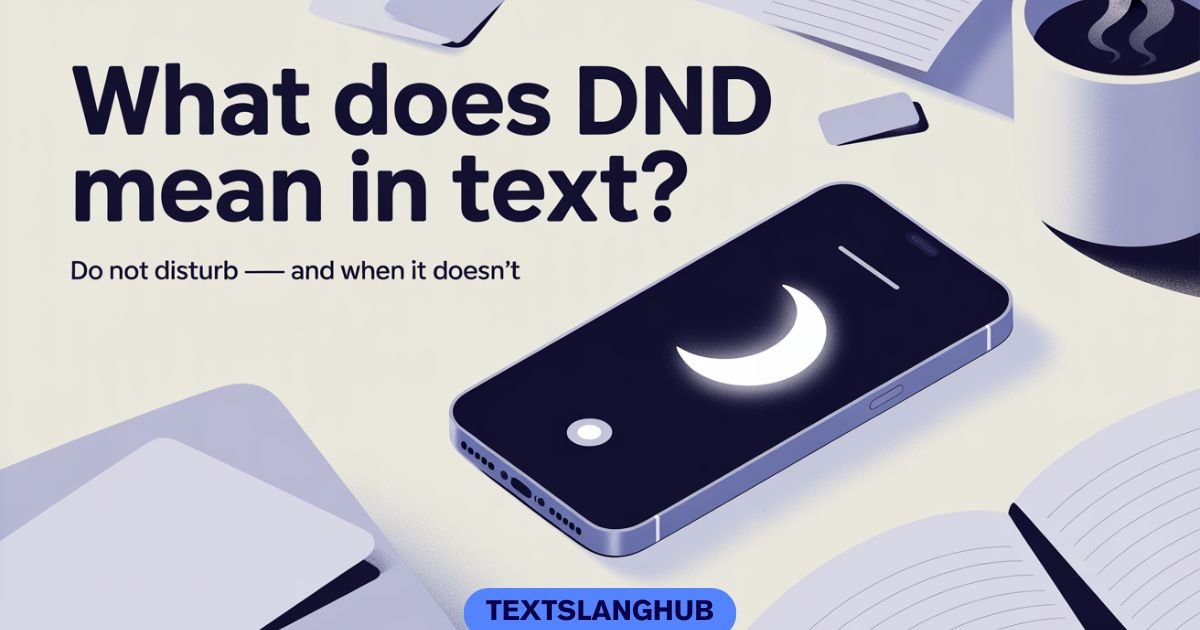
What Does DND Mean in Text? Do Not Disturb — and When It Doesn’t
You get a text back that says “sorry, I was on dnd” — or a friend drops “dnd tonight?” in the group chat. Same three letters, totally different vibe. So what does DND mean in text? Nine times out of ten it means Do Not Disturb, the setting that mutes your phone. But not every time. Let’s decode it in a few seconds, then go deeper.
DND means “Do Not Disturb” in text — a phone or app setting that silences notifications so a person isn’t pinged by your message. It can also stand for Dungeons & Dragons, the tabletop game, usually around game night. Context tells you which one someone means.
DND in 5 seconds
If you only read one thing, read this:
- Most common: Do Not Disturb (phone/app mode that mutes alerts)
- Second most common: Dungeons & Dragons (the game, often written DnD)
- Tone: neutral — it’s not rude or flirty on its own
- Where you’ll see it: iPhone, Android, Slack, Discord, Snapchat, group chats
That covers 95% of cases. The rest of this guide is for when you want to read the room.
The two meanings that actually matter
Most texting acronyms have one job. DND has two, and they barely overlap.
1. Do Not Disturb. This is the phone setting. When someone’s on DND, their device stops buzzing, ringing, and flashing. Your message still arrives — it just lands quietly. People mention it to explain a slow reply: “was on dnd all morning, just saw this.”
2. Dungeons & Dragons. The fantasy tabletop game, usually styled DnD or D&D. When plans and dice are in the air, this is your term. “You free for dnd Saturday?” is game night, not a phone status.
There’s no widely used vulgar meaning here, so DND is safe to send in almost any chat. You may occasionally see it as “drag and drop” in tech talk, but that’s niche and the context makes it obvious.
How do you know which DND someone means?
This is the part competitors skip. Both meanings are common, so context is your decoder. Watch for these signals:
- Talk about replies, notifications, or being busy? → Do Not Disturb. “Text me later, I’m putting my phone on dnd.”
- Talk about plans, a day, dice, characters, or a campaign? → Dungeons & Dragons. “Bringing snacks to dnd?”
- Written as DnD or D&D? → almost always the game.
- Said inside a settings menu or about a person’s phone? → the mute setting.
Quick test: swap in “Do Not Disturb” and see if the sentence still makes sense. “Bringing snacks to Do Not Disturb?” — nope. That’s game night.
Where DND pops up (platform by platform)
The word travels across apps, and the meaning shifts slightly with each one.
- iPhone / Android: the built-in Do Not Disturb (or Focus) mode. Purely the mute setting.
- Slack: your status shows a little “DND” moon when you’ve paused notifications. Coworkers use it to mean don’t ping me right now.
- Discord: a red DND badge on your profile. Handy for gamers and study servers who want to lurk without alerts.
- Snapchat / Instagram DMs: more casual — people say they’re on DND to explain why a snap or DM sat unopened.
- WhatsApp / group chats: usually the phone setting, dropped as a quick excuse for a late reply.
Same three letters, one core idea across all of them: notifications are muted.
Read Also: FR Full Form in Chat: What It Means and How to Use It
Are they on DND or just ignoring you?
Here’s the emotional read nobody talks about. Sometimes DND is real. Sometimes it’s a soft exit.
Person A: you up? Person B: (three hours later) sorry was on dnd 😅
Was Person B really on Do Not Disturb — or using it as a polite cover to reply on their own time? Honestly, both happen. Don’t spiral over it.
Signs it’s genuine: they reply warmly once they surface, and it lines up with sleep, work, or a class. Signs it might be a gentle brush-off: it becomes a pattern, and the energy feels flat when they do answer. One “was on dnd” is nothing. A weekly one is a conversation worth having — not a text war.
The “notifications silenced” thing on iPhone
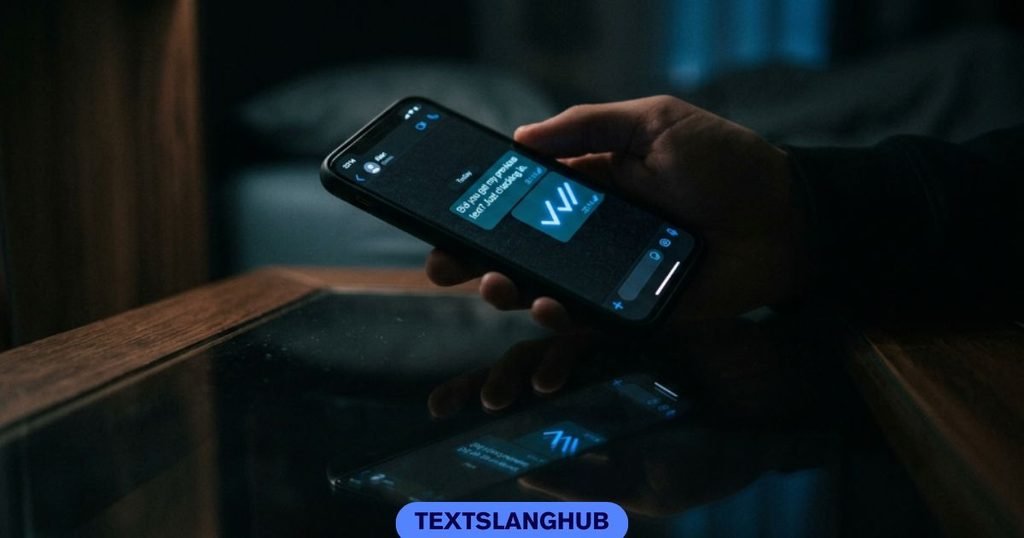
You’ve probably seen it: under your blue message, a small line reads “[Name] has notifications silenced.” People panic and assume they’re blocked. They’re not.
That banner just means the other person has Do Not Disturb (or a Focus mode) turned on. Your text delivered fine — their phone simply won’t buzz for it. On iPhone you can even tap “Notify Anyway” to break through for something urgent. It’s the DND setting doing exactly its job, nothing personal.
Reply like this when someone’s on DND
No need to overthink your response. Match the vibe:
When a friend explains a slow reply
“all good, no rush!”
When you actually need them now
“totally fine you’re on dnd — ping me when you’re free, kind of time-sensitive tho 🙏”
When someone invites you to game night
“I’m in for dnd, what should I bring?”
When you want to set your own boundary
“heads up, going on dnd to focus — I’ll catch you tonight”
Notice the last one. Announcing your DND before you go quiet is a small kindness. It stops people wondering if they’re being ghosted.
DND vs busy vs AFK vs read
These get mixed up. Here’s the clean difference:
| Term | What it means | What your message does |
| DND | Do Not Disturb — alerts muted | Delivers silently, no buzz |
| Busy | Occupied right now | May or may not see it |
| AFK | Away From Keyboard | They’ve stepped away |
| Left on read | Seen, not answered | Opened, no reply |
The big one to know: DND is not the same as being left on read. On DND, they likely haven’t even seen your text — the phone never lit up. Left on read means they saw it and chose not to reply. Very different feelings, very different responses.
Is it rude to leave your DND on all day?
Short answer: no. Do Not Disturb is a boundary, not an insult.
People use it for sleep, deep work, meetings, driving, or just a break from the constant ping. You’re allowed to protect your attention. The only time it reads as cold is when you say you were on DND but the person can see you were clearly active elsewhere. Honesty keeps it clean.
If you rely on DND a lot, a one-line heads-up in a close chat — “I keep my phone on dnd during work hours” — sets expectations so nobody takes the silence personally.
Read Also: OP Full Form in Chat: What It Really Means
The mistakes people make with DND
A few slip-ups worth dodging:
- Assuming DND = blocked. It doesn’t. Your text still delivers.
- Reading it as flirty or shady. It’s neutral. Don’t overanalyze.
- Mixing up DND and D&D. Check for plans-vs-phone context first.
- Using it as a repeat excuse. Once is fine. As a pattern, people notice.
- Ignoring an urgent tag. If someone marks a text time-sensitive, DND may still let it through — check before assuming you missed nothing.
Frequently Asked Questions
What does “DND” mean in slang?
In slang, DND means “Do Not Disturb.” It shows that a person has muted their phone and cannot get alerts right now.
What does “dnd” mean when a girl says it?
It means the exact same thing: “Do Not Disturb.” She simply had her phone on silent, so the message carries no hidden or flirty meaning.
What does DND mean in Gen Z?
Gen Z uses DND to mean “Do Not Disturb.” They often mention it to explain a slow reply or to set a quiet boundary.
What does DND mean on Snapchat?
On Snapchat, DND means someone put their phone on “Do Not Disturb.” Your snap still sends, but their phone stays quiet until they turn it off.
What is DND in chatting?
In chatting, DND means “Do Not Disturb.” It tells you the person has silenced alerts, so they may reply a little later than usual.
The bottom line
What Does DND Mean in Text? In almost every chat, DND means “Do Not Disturb.” A person turns on this setting to mute their phone. Your text still arrives, but the phone stays quiet. Now and then, DND means Dungeons & Dragons, the fun tabletop game. You just need to check the words around it. Plans and dice point to the game. A quiet phone points to the setting.
You now hold a simple skill. You can read those three letters with full confidence. DND stays calm and polite, so nobody feels upset by it. Match your reply to the vibe, stay patient, and keep things friendly. Remember the trick, trust your gut, and you will always understand it.
Related Guides:
1: JS Meaning in Chat: “Just Saying,” Explained
2: IMY Meaning in Text: What It Really Means (and How to Reply)
3: FWB Meaning in Text: What It Really Means in Chat, Dating & Social Media
4: HRU Meaning in Text: What It Really Means in Messages & Social Media (2026 Guide)
5: What Does XD Mean in Text? Full Meaning, Usage, Examples & Social Media Guide

2 Comments