
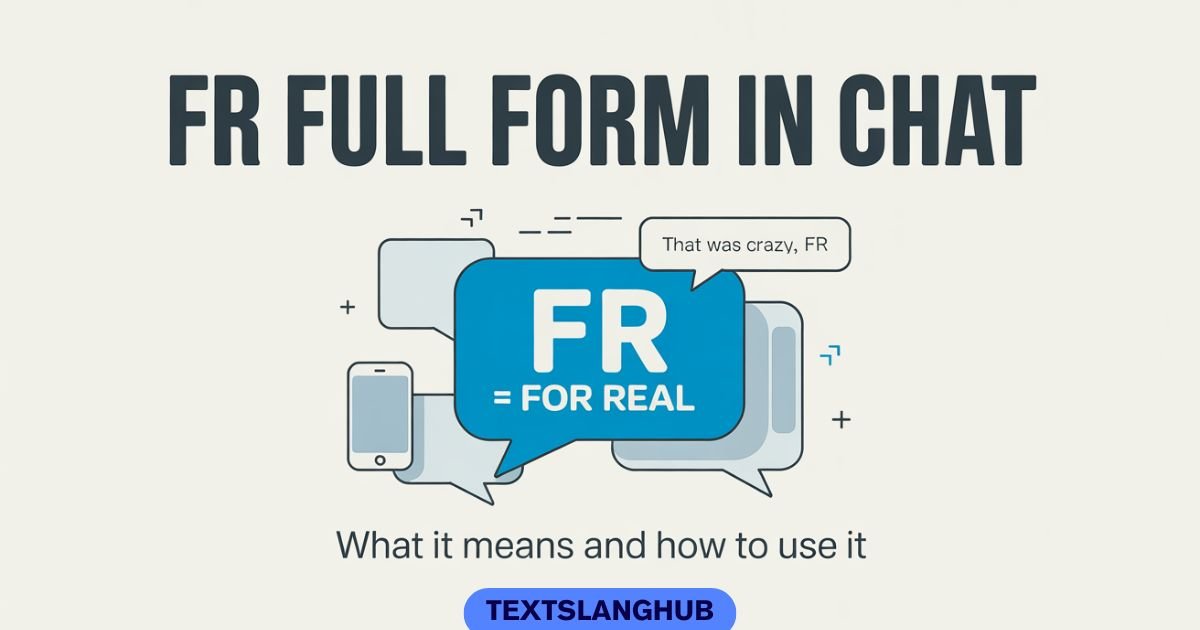
FR Full Form in Chat: What It Means and How to Use It
You typed something you actually believe, and someone fired back “fr.” Or you sent a wild story and got “fr??” No explanation, no context. So here’s the short version of the FR full form in chat, plus every way people really use it.
FR is one of those tiny abbreviations that does a surprising amount of work depending on where it sits and how it’s punctuated. Let’s decode it.
The 5-second answer FR stands for “for real.” In chat, FR is a fast way to agree with someone or stress that you mean what you’re saying — basically “I mean it” or “same, 100%.” Add a question mark (“fr?”) and it flips to “seriously?” Tone and placement decide which one you get.
The FR intensity ladder: fr → fr fr → frfr
Here’s the thing most search results skip. FR isn’t one setting. It’s a dial.
- fr — normal agreement or emphasis. “That test was hard fr.”
- fr fr — spaced out, said with feeling. Stronger. “I’m tired fr fr.”
- frfr — mashed together, max sincerity. “I’d move there frfr, no hesitation.”
The more it repeats, the more the person means it. Think of it like nodding once versus nodding really hard.
Person A: you actually think we’ll win? Person B: frfr, we’re not losing this one
That “frfr” is doing more than “fr” would. It reads like a promise, not a shrug. Once you notice the ladder, you’ll spot it everywhere.
What does FR stand for?
FR is short for “for real.” It’s texting slang — an acronym-style abbreviation that crushes two words down to two letters.
It comes from spoken slang. “For real?” and “for real, though” have been in everyday English for decades. Texting just squeezed the phrase into initials, the same way “to be honest” became “tbh” and “not gonna lie” became “ngl.” No secret meaning, no code. Just a shortcut.
So when FR lands in your DM, read it as someone saying “for real” out loud.
The meaning that does the real work
Most of the time, FR is an agreement and emphasis marker. It lives in the same family as “bet,” “deadass,” “ong” (on god), and “no cap.” All of them are ways to say I’m not joking, I mean this.
FR has two main jobs:
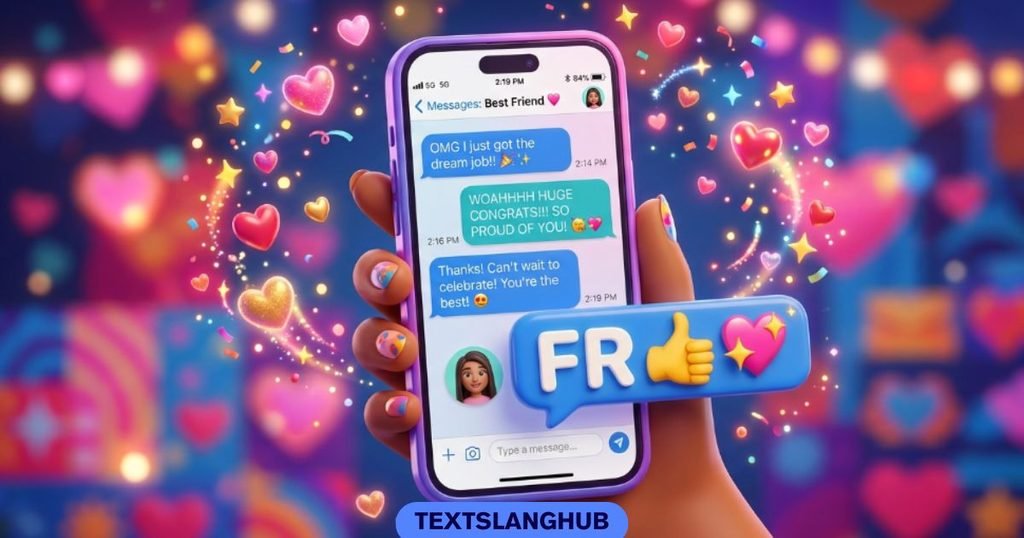
1. Agreeing with someone. They say something, you drop “fr” to co-sign it.
Maya: this heat is unbearable Sam: fr, I can’t even go outside
2. Stressing your own point. You tack “fr” onto your own sentence to show you’re being sincere.
“I’ve watched that movie like six times fr.”
Either way, the vibe is casual and honest. It’s warm, not aggressive. When a friend says “fr” back to you, they’re on your side — you said something and they felt it too.
“fr” or “fr?” — same letters, opposite jobs
This is where people get tripped up, so read this part twice.
FR as a statement = agreement. Calm, chill, “yeah, same.”
FR as a question = disbelief. “fr?” or “fr??” means “wait, seriously?” It can be excited or skeptical, depending on the news.
Jordan: I got the job Alex: fr?? congrats!!
But watch the punctuation, because it carries all the weight here:
- “fr!!” → hyped, genuine, all in
- “fr?” → surprised, curious, wants confirmation
- “fr.” → could be dry, deadpan, or done with the conversation
That last one is sneaky. A flat “fr.” with a period can read as sarcastic — like “sure, buddy.” Same two letters, cold delivery. When you’re unsure which version you’re getting, look at what came right before it and how the chat feels.
Read Also: OP Full Form in Chat: What It Really Means
Reply to FR without sounding dry
Someone hit you with FR and you blanked. Here are copy-paste replies for different vibes.
If they agreed with you (statement FR):
- “right?? glad I’m not the only one”
- “exactly fr”
- “see, you get it”
If they’re asking “fr?” (surprise):
- “yeah I’m dead serious 😭”
- “frfr no cap”
- “wish I was joking lol”
If it felt sarcastic and you want to check:
- “wait are you being real or nah”
- “that a real fr or a fake fr 💀”
If you just want to keep it moving:
- “fr fr” (mirror it back — instant agreement)
- “100%”
The move is matching their energy. If they double it (“fr fr”), double it back. If they’re hyped, be hyped. Mirroring is how you keep a chat feeling natural instead of stiff.
Annotated chat: FR in the wild
Let’s read one short conversation and label what each FR is actually doing.
Priya: ngl this new album is his best one Leo: fr (← agreement — Leo co-signs) Priya: the third song had me replaying it all day Leo: fr?? I skipped that one (← question — surprise, wants to check) Priya: go back rn, deadass Leo: bet, frfr gonna listen after this (← max sincerity — Leo means it)
Same two letters, three different jobs, all in one chat. Agreement, then surprise, then a genuine promise. Once you can read the tone, FR stops being confusing.
FR vs FS vs deadass vs ong
FR has cousins. They overlap, but each has its own flavor.
- FR (for real) — sincere agreement or emphasis. The all-rounder.
- FS (for sure) — confirming or agreeing to a plan. More “yes, count me in.”
- deadass — very serious, a little harder. “I’m deadass not going.”
- ong (on god) — swearing you mean it, the strongest of the group.
Quick test: if you’d nod and say “same,” use fr. If you’d say “yep, I’ll be there,” use fs. If you want to swear on it, ong.
Jamie: you free Saturday? Riley: fs, I’ll pull up (← that’s “for sure,” not “for real”)
They look similar, but they do different jobs. Swapping FR and FS is the number-one slip-up — one agrees with a feeling, the other commits to a plan.
Where you’ll actually see FR
FR lives everywhere young people text, but it hits a little differently by platform.
- TikTok comments — agreeing with a video or another comment. “fr this is so true.”
- Snapchat & DMs — quick back-and-forth, lots of “fr fr.”
- Instagram — replies and story reactions.
- WhatsApp & group chats — co-signing whatever someone just dropped.
- Discord & gaming chats — reacting mid-game without breaking flow.
It’s mostly a Gen Z and Gen Alpha thing, but it’s leaked into everyone’s texting by now. Plenty of parents and coworkers use it too.
One heads-up: in a totally different context — a country-code list, a shipping form, a weather app — “FR” can mean France. In a normal chat, ignore that completely. Nobody’s texting you a country code.
Is FR rude or totally fine?
Totally fine. FR is friendly by default. It’s agreement, and agreement feels good to receive.
The only time it stings is that dry “fr.” with a period, dropped into a tense conversation — that can read as dismissive or sarcastic. But that’s a tone problem, not an FR problem.
So it’s safe to send in almost any casual chat. The one place to leave it out is anything formal. You wouldn’t write “sounds good fr” to your boss’s boss. Save it for friends and group chats.
Quick guide: send it or skip it
Send FR when:
- You genuinely agree and want to co-sign it
- You’re stressing that you mean what you said
- The chat is casual — friends, DMs, group threads
Skip FR when:
- You’re writing an email or a work message
- The convo is serious and a dry “fr.” might read as cold
- You actually mean “for sure” about a plan — use FS instead
When in doubt in a casual chat, FR is almost always safe.
The mistakes people make with FR
- Using it at work. FR is slang. Keep it out of emails and professional messages.
- Reading “fr?” as agreement. The question mark flips the whole meaning. “fr?” wants an answer.
- Overdoing the frfr. If everything is “frfr,” none of it lands. Save the doubled version for when you really mean it.
- Missing the deadpan. A lone “fr.” can be sarcasm. Read the mood of the chat first.
- Confusing it with FS. FR is “same, I feel that.” FS is “yes, I’ll do it.”
Read Also: JS Meaning in Chat: “Just Saying,” Explained
FR for parents and teachers
Spotted FR in your kid’s texts? Breathe — it’s harmless. FR means “for real.” It’s how young people say “I agree” or “I’m being honest.”
- “fr” = “yeah, true” or “I mean it”
- “fr?” = “really? seriously?”
- “fr fr” / “frfr” = “I 100% mean it”
There’s nothing hidden or unsafe about it. It’s the texting version of nodding along. If your teen types “that’s unfair fr,” they’re just saying they genuinely think it’s unfair — no code, no cause for worry.
FAQ
What is the full form of FR in chat?
The full form of FR in chat is “for real.” People use it to agree with someone or to show they mean what they say.
How to reply FR in chat?
Match their energy — reply “fr fr” or “exactly” to agree, or “yeah I’m serious” if they asked “fr?” in surprise.
What does FR mean in dating?
In dating, FR shows someone is being sincere about their feelings or plans, like saying “I mean it, for real.”
What does Frrr mean on Instagram?
Frrr means “for real” with extra emphasis. The added letters stress that the person strongly agrees or truly means it.
What does frr mean from a girl?
From a girl, frr means “for real.” She agrees with you or confirms she is being honest and sincere.
Bottom line
The FR Full Form in Chat is “for real.” People use FR to agree with a friend or to show they mean what they say. When you read FR as a statement, it shows agreement. When you see “fr?” with a question mark, it shows surprise. Small marks like these change the meaning, so you should always look at them with care.
Now you know how FR works, and you can use it with confidence. Keep FR for casual chats with friends, and use full words in school work or formal notes. Match the other person’s energy, and read the tone before you reply. Follow these simple steps, and you will always understand the FR Full Form in Chat. That is all there is to it, fr.
Related Guides:
1: IMY Meaning in Text: What It Really Means (and How to Reply)
2: FWB Meaning in Text: What It Really Means in Chat, Dating & Social Media
3: HRU Meaning in Text: What It Really Means in Messages & Social Media (2026 Guide)
4: What Does XD Mean in Text? Full Meaning, Usage, Examples & Social Media Guide
5: WTM Meaning in Text: What It Really Means in Chat, Snapchat & Social Media


One Comment