
KK Meaning in Text: What It Stands For and How to Use It
You just got a “kk” and paused for a second. Friendly? Annoyed? Nothing at all? If you’ve searched the kk meaning in text, you want the fast version first and the nuance right after. Good news: it’s one of the easier bits of texting slang to decode — but there’s a small tone trick most people miss.
Let’s clear it up.
The 5-second answer: “KK” means “okay, okay” or “okay, cool.” It’s a quick, friendly way to say you got the message and you’re on board. The doubled K makes it warmer and more relaxed than a single “k,” which can read as cold or irritated. Think casual thumbs-up, no attitude attached.
What “kk” actually means
At its core, “kk” is just “okay.” People type it to confirm they’ve read something and they agree or understand. It’s an acknowledgment — a way of saying “got it, we’re good” without a full sentence.
You’ll see it after plans get made, after instructions, or after any message that doesn’t really need a reply but feels rude to leave on read.
Example:
Sara: meet at the library at 4?
Dan: kk see you there
No drama, no deep meaning. Dan agreed and moved on. That’s 95% of how “kk” gets used.
The coldness scale: k vs kk vs okay
Here’s the part competitors gloss over. In texting, these four replies all mean “okay” — but they feel completely different. Tone lives in the tiny details.
| You type | How it lands |
| k | Cold, blunt, sometimes annoyed. Feels like a door closing. |
| kk | Casual and friendly. Chill agreement. |
| okay | Neutral to slightly serious, depending on context. |
| okay. (with a period) | Passive-aggressive. Something’s up. |
The jump from “k” to “kk” is the whole story. A single “k” can make the other person wonder if they upset you. Adding one more letter softens the entire vibe. It’s the difference between a shrug and a smile.
So if you ever want to agree without sounding short, “kk” is your safe bet.
Why two K’s feel friendlier than one
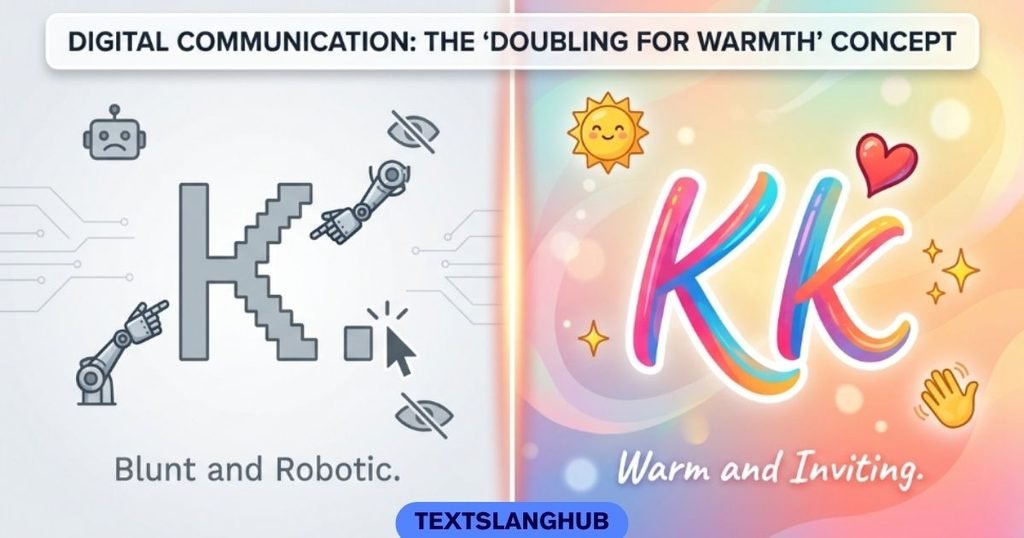
This sounds silly, but it’s real: doubling a letter reads as warmer. It’s the same reason “hey” feels flatter than “heyy,” and “yes” feels stiffer than “yess.”
The extra character signals a bit of effort and a bit of lightness. Your brain reads it as relaxed, not clipped. A single “k” looks like you couldn’t be bothered to type anything more — even when that’s not what you meant.
That’s why “kk” became the polite default for a lot of people. It gets the job done and keeps the mood friendly. Small letter, big tone shift.
Read Also: What Does ASL Mean Texting? Here’s the Real Answer
Where you’ll bump into “kk”
“kk” travels across almost every app, but the flavor shifts a little depending on the platform.
- Gaming chat (Discord, in-game lobbies): This is where “kk” grew up. Quick “kk” before a match starts, or “kk gg” (okay, good game) after. Fast hands, no time for full words.
- WhatsApp and group chats: Confirming plans, times, and “on my way” moments. Very common with friends and family.
- Snapchat and Instagram DMs: Low-effort agreement between friends. Often paired with an emoji.
- Work chats (Slack, Teams): Some people use “kk” casually with coworkers, but read the room — in formal threads, “Sounds good” or “Got it” is safer.
Across all of them, the meaning stays the same. Only the formality changes.
How to reply to “kk” without overthinking it
Honestly? Most of the time, you don’t need to reply at all. “kk” is a conversation-ender. It’s the other person saying “we’re done here, all good.”
But if a response feels natural, match the energy:
- Keep it light: 👍 or “cool” or “see you then”
- Add warmth: “kk 😄 talk soon”
- Wrap plans: “perfect, text me when you’re close”
- If it felt cold and you’re unsure: “you good?” — but only if the whole convo felt off, not just because of a short reply.
The one thing to avoid: reading too much into it. “kk” almost never carries hidden anger. If someone’s mad, they usually make it obvious.
Is “kk” rude or passive-aggressive?
Usually not. On the rudeness scale, “kk” sits firmly on the friendly side. It’s the cure for the cold single “k,” not the cause.
That said, context can flip anything. A few situations where “kk” might sting:
- After a long, emotional message, a two-letter “kk” can feel dismissive.
- If someone shares exciting news and you reply “kk,” that reads flat.
- In a tense argument, any short reply can feel like a brush-off.
So the rule is simple: match the weight of the message. Big moment = more words. Casual logistics = “kk” is perfect.
The mistakes people make with “kk”
A few common slip-ups:
- Using it after emotional messages. “My grandma’s in the hospital” → “kk” is a disaster. Slow down and reply properly.
- Sending it to your boss in a serious thread. It can read as careless. Save it for casual coworkers.
- Reading anger into it that isn’t there. If a friend sends “kk,” they’re almost certainly just agreeing. Don’t spiral.
- Overusing it. If every reply is “kk,” conversations start to feel like you’ve checked out. Mix it up.
Small tool, wrong moment — that’s where “kk” goes sideways.
Where “kk” came from
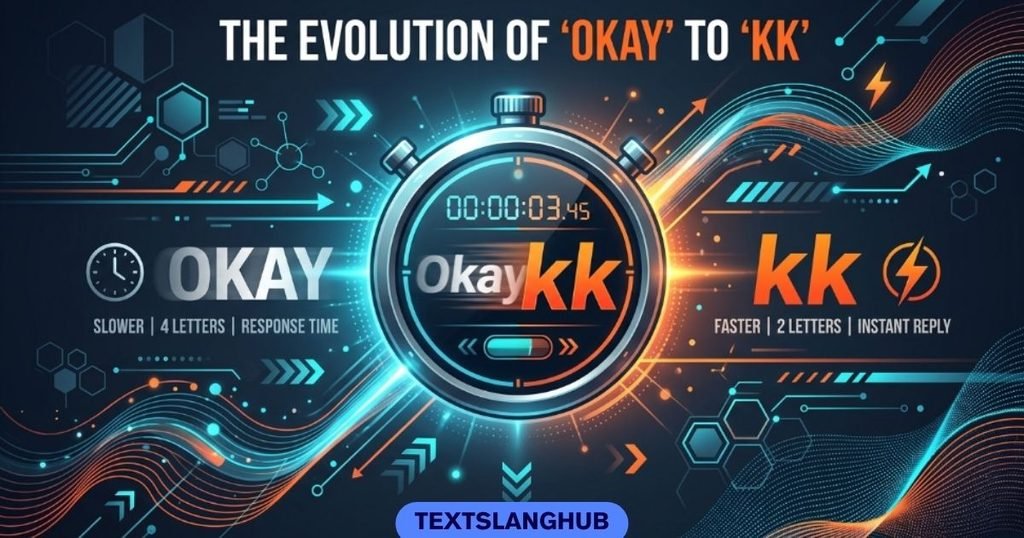
“kk” has deep roots in gaming culture. In fast-paced multiplayer games, players needed to confirm things instantly, mid-action. Typing “okay” cost precious seconds. “kk” was faster, and it stuck.
From there it spilled into general internet slang, then into everyday texting. Some people trace the extra K to a friendlier, rounder feel than a lone “k” — and that theory matches how it’s used today. Either way, by the 2010s it was everywhere, and it hasn’t gone anywhere since.
Now it’s just part of the standard texting toolkit, used by teens, adults, and gamers alike.
Read Also: HYD Meaning in Text: What It Means and How to Reply
“kk” for parents, teachers, and anyone over 30
If your kid or student texts you “kk,” here’s the plain-English translation: “okay, got it.” That’s it. No slang trap, nothing to worry about.
It’s a completely safe, kid-friendly abbreviation with no hidden or adult meaning. When you see “kk,” the person is simply agreeing or confirming they read your message.
If you want to reply and sound natural, “kk” back works fine — or just a thumbs-up. You don’t need to decode anything further.
Frequently Asked Questions
What does KK mean for a girl?
When a girl sends “kk,” it means the same as anyone else: “okay” or “okay, cool.” It shows she read your message and agrees, in a friendly and relaxed way.
What does “KK” mean in Gen Z slang?
In Gen Z slang, “kk” is a warm, casual “okay.” The extra K makes it sound softer and friendlier than a cold single “k.”
Why do people respond to KK?
People respond with “kk” to confirm they got the message and they agree. It is a quick, polite way to end a chat without leaving someone on read.
What does “kk” mean in chat?
In chat, “kk” means “okay, okay” or “okay, cool.” It is a fast acknowledgment that says “got it, we’re good.”
How to reply to KK?
Most of the time, you do not need to reply, since “kk” ends the chat. If you want to, a thumbs-up, “cool,” or “see you then” works well.
The bottom line
The KK Meaning in Text is very simple to learn. The letters “kk” just mean “okay” or “okay, cool.” People type it to show that they read your message and they agree. The best part is the second K. That extra letter makes the reply sound warm and friendly. A single “k” can sound cold, but “kk” keeps the mood nice and relaxed.
You can use “kk” with your friends and family in almost any chat app. It works well for quick plans and simple agreements. You should skip it after sad or serious messages, because those deserve more words. Keep this small tip in mind, and you will always send the right message. Now you know “kk” the easy way.
Related Guides:
1: DTF Meaning in Chat: What It Really Stands For
2: What Does DND Mean in Text? Do Not Disturb — and When It Doesn’t
3: FR Full Form in Chat: What It Means and How to Use It
4: OP Full Form in Chat: What It Really Means
5: JS Meaning in Chat: “Just Saying,” Explained

2 Comments