
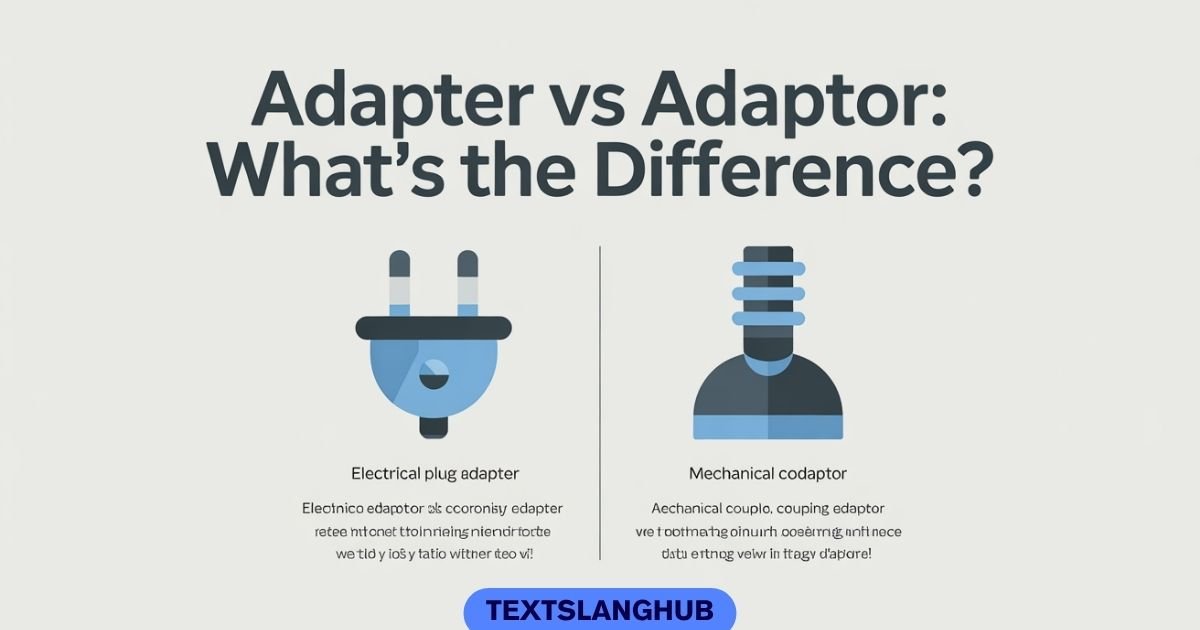
Adapter vs Adaptor: What’s the Difference?
You typed a word, your spell-check underlined it, and now you’re stuck. Is it adapter or adaptor? The short version of adapter vs adaptor: they’re the same word with two spellings, and neither is wrong. But which one you should use depends on where you live and what you’re writing about.
Let’s clear it up fast, then go deeper.
🟢 The 5-second answer
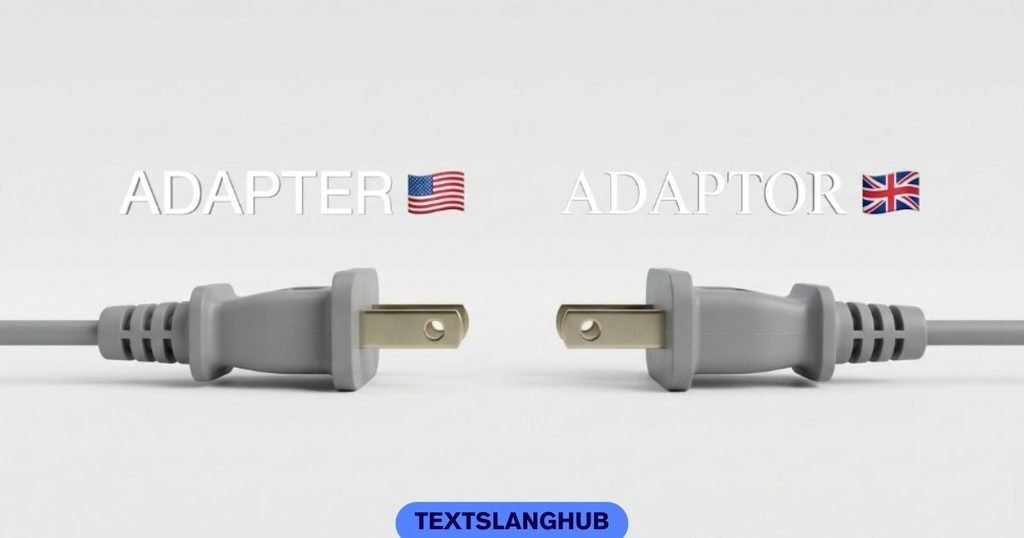
Adapter and adaptor are two spellings of the same word, meaning a device or person that connects or adjusts things. Adapter is the more common global spelling and standard in US English and technology, while adaptor is a British and Australian variant often used for electrical plugs. Both are correct.
Are “adapter” and “adaptor” actually different words?
No. This is the part that surprises people.
They mean the same thing. They’re pronounced the same way — uh-DAP-ter — no matter which spelling you pick. The only difference is the last two letters: -er vs -or.
Both come from the Latin verb adaptare, “to fit.” English just never fully agreed on how to end the word, so we got two versions that both stuck around.
Think of it like gray and grey, or color and colour. Same word, two accepted spellings, mostly split by region.
The regional split: US vs UK vs everyone else
This is the real heart of the question.
In the United States, adapter is the standard. You’ll see it on packaging, in tech manuals, in newspapers. Adaptor looks slightly off to American eyes.
In the UK and Australia, both spellings show up, but adaptor is more common in everyday use — especially for physical things you plug in. A Brit heading abroad packs a “travel adaptor,” not a “travel adapter.”
Here’s the twist most quick guides skip: even in Britain, major dictionaries list adapter as the main headword. So adapter is safe almost everywhere. Adaptor is the one with a home turf.
Quick real-world snapshot:
Priya: Do I need an adapter for my laptop in Spain?
Tom (UK): Yeah grab a European travel adaptor, they sell them at the airport.
Both of them are right. They just spell it by habit.
Read Also: That’s Mean vs That Means: What’s the Difference?
Where you’ll actually see each spelling
The spelling often shifts depending on the field. This is the useful part nobody puts in one place.
Technology and electronics → almost always adapter. Power adapter, AC adapter, network adapter, Bluetooth adapter, graphics adapter. If it plugs into a computer, the industry standard is adapter, worldwide.
Travel and electrical plugs → often adaptor in British and Australian English. “Plug adaptor,” “travel adaptor,” “3-pin adaptor.”
Film and publishing → the person who turns a book into a screenplay is usually the adapter (US) or occasionally adaptor (UK). “She’s the adapter of the novel for Netflix.”
Biology → here it flips. Scientists usually write adaptor — as in adaptor protein or Francis Crick’s famous “adaptor hypothesis” about how genetic code gets read. In labs, adaptor is the traditional choice.
So the “correct” spelling can literally depend on which room you’re standing in.
The one distinction some Brits quietly make
Here’s a nuance the generic spelling posts miss entirely.
A small group of careful British writers use the two spellings to mean two slightly different things:
- Adaptor = the physical object. The plug, the connector, the gadget.
- Adapter = the person or thing that adapts. The screenwriter, the flexible employee, the animal that adjusts to a new climate.
So under this logic: “The adapter used a clever adaptor to charge her phone.”
Important caveat: this is a preference, not a rule. Most people and most dictionaries don’t enforce it. Don’t correct anyone for ignoring it, and don’t stress about following it. But now you know why some British writing splits them on purpose.
Which spelling should you use?
Skip the overthinking. Match your reader.
- Writing for a US audience? Use adapter. Always.
- Writing about tech, hardware, or software? Use adapter, even in the UK.
- Writing about travel plugs for a British or Australian audience? Adaptor fits the vibe, but adapter still works.
- Not sure who’s reading? Default to adapter — it’s the global safe pick.
- Writing a science paper on cell biology? Use adaptor and check the journal’s style.
The single most important rule: pick one and stay consistent in a document. Switching between adapter and adaptor in the same article is what actually looks like a mistake — more than either spelling on its own.
Adapter vs adaptor: side-by-side
| Adapter | Adaptor | |
| Meaning | Same | Same |
| Pronunciation | uh-DAP-ter | uh-DAP-ter |
| Most common in | US English, global default | British & Australian English |
| Standard in tech | ✅ Yes | Rarely |
| Common for travel plugs | Sometimes | ✅ Often (UK/AUS) |
| Biology term | Sometimes | ✅ adaptor protein |
| “Person who adapts” | ✅ Usual | Occasional (UK) |
| Wrong anywhere? | No | No |
The mistakes people make with adapter vs adaptor
Mistake 1: Thinking one is a typo. Neither is. Both are in Oxford, Cambridge, and Merriam-Webster.
Mistake 2: Mixing them in one piece. If you open with adapter, don’t drift into adaptor three paragraphs later. Consistency beats “correctness” here.
Mistake 3: Using adaptor in US tech writing. It’s not wrong, but it reads as unusual and can undercut a professional tone with an American audience.
Mistake 4: Assuming they sound different. They don’t. Some people invent a fake pronunciation gap. There isn’t one.
Mistake 5: Correcting someone else’s spelling. Since both are valid, “fixing” a friend’s adaptor to adapter is a losing battle. Let it go.
Does the spelling change the plural or other forms?
Nope — the forms just follow the spelling you chose.
- Plurals: adapters / adaptors
- Verb “adapt” stays the same for everyone: adapt, adapts, adapted, adapting
- The adjective is adaptable (never “adaptorable”)
The -er / -or wobble only happens on this one noun. Everything built around it behaves normally.
Read Also: SS Meaning in Text: What It Really Means
Parent, teacher, and student plain-English version
If a kid asks which is right for a spelling test or an essay:
Tell them both are correct, but adapter is the safer, more common choice — especially in the US and in anything to do with computers or electronics. In UK schools, adaptor is also fine. The only firm rule is to spell it the same way every time in a single piece of writing.
For English learners: default to adapter. It’ll be accepted everywhere and it’s the version you’ll meet most in tech and international English.
Frequently Asked Questions
What is the correct, adaptor or adapter?
Both are correct — adapter is the global and US standard, while adaptor is a common British and Australian variant. When unsure, use adapter.
What is the difference between “adapter” and “adopter”?
An adapter connects or adjusts things (like a plug); an adopter is a person who takes up something new, like an “early adopter” of tech. Different words, different meanings.
Which spelling, adapter or adaptor, is correct?
Neither is wrong. Adapter is more common worldwide and standard in tech; adaptor is chiefly British/Australian, often for travel plugs. Just stay consistent.
What is the difference between a socket and an adapter?
A socket is the fixed outlet you plug into; an adapter is the device that lets an incompatible plug or connector fit that socket. The socket receives, the adapter bridges.
What are the types of adapters?
Common types include power/AC adapters, travel plug adapters, network (Wi-Fi/Ethernet) adapters, Bluetooth adapters, USB and USB-C adapters, and video adapters like HDMI-to-VGA.
The bottom line
The whole adapter vs adaptor debate has a boring, freeing answer: they’re the same word, and you can’t really get it wrong. Use adapter for the safest, most global choice — and definitely for anything tech. Reach for adaptor if you’re writing for a British or Australian reader, or naming a travel plug. Then just pick your spelling and stick with it. That consistency matters far more than the two letters at the end.
Related Guides:
1: SP Meaning in Text: Every Meaning, Decoded Fast
2: IMAO Meaning: What It Really Stands For (and Why It’s Often Just LMAO)
3: Hmm Meaning in Text: What It Signals and How to Reply
4: Flew or Flown? The Simple Rule (With Easy Examples)
5: BB Meaning in Text: What It Stands For and When It’s Flirty



3 Comments