

Flew or Flown? The Simple Rule (With Easy Examples)
Mixing up flew or flown is one of the most common slip-ups in everyday English — and it’s an easy fix. Both words come from the verb fly, but they do different jobs. Nail the job, and you’ll never second-guess yourself in a text, an email, or an essay again.
Here’s the short version before we dig in: use flew when the action stands alone, and flown when a helper word like has, have, or had comes first. That one habit solves almost every case.
Snippet answer: Flew and flown are both past forms of the verb fly. Use flew for the simple past when it stands alone — I flew to Rome. Use flown as the past participle with a helper verb like has, have, or had — I have flown before.
The 5-second answer
- Flew = simple past. It stands on its own. → The plane flew over the city.
- Flown = past participle. It always needs a helper verb (has, have, had, was, were). → The plane has flown over the city many times.
If you remember one thing today, make it this: no helper word → flew. Helper word → flown.
What “flew” and “flown” actually mean
Fly is an irregular verb, which is exactly why it trips people up. Regular verbs just tack on -ed (walk → walked → walked). Irregular verbs change shape instead.
The three main forms of fly are:
- fly (present) — Birds fly south in winter.
- flew (simple past) — The birds flew south last month.
- flown (past participle) — The birds have flown south already.
Teachers call these the “principal parts”: fly, flew, flown. Say them out loud a few times and they start to stick.
Flew describes a finished action in the past. Flown describes an action tied to a helper verb — usually the perfect tenses or the passive voice. That’s the whole difference in a nutshell.
Why does this pair confuse everyone?
Blame the irregular verb. English has a pile of them, and fly is one of the messier ones because all three forms look totally different: fly, flew, flown. Nothing rhymes, nothing repeats.
Compare that to a tidy verb like play → played → played, where the past and participle match. With fly, your brain has to store two separate past forms and remember when each one shows up. So reaching for the wrong one isn’t carelessness — it’s just an awkward verb doing awkward things.
The one-second helper-verb test

Here’s a trick your English teacher probably never spelled out. Before you write flew or flown, scan the words right in front of it.
Look for one of these helpers: has, have, had, was, were, been.
- Helper is there → use flown.
- No helper → use flew.
Try it:
- “She ___ to Paris yesterday.” → No helper. → She flew to Paris.
- “She has ___ to Paris twice.” → Helper (has). → She has flown to Paris.
That’s the entire rule in one move. Most guides bury this; it’s honestly the fastest fix there is.
Read Also: BB Meaning in Text: What It Stands For and When It’s Flirty
See it in action
Real sentences make it click. Watch how the helper verb flips the choice.
Simple past (flew):
- Maya flew home for the holidays.
- The drone flew straight into the tree.
- We flew economy to save money.
Present perfect (have/has flown):
- I have flown that airline before.
- He has flown more miles than anyone I know.
Past perfect (had flown):
- By sunrise, the geese had flown away.
Passive voice (was/were flown):
- The injured hiker was flown to the hospital.
- Emergency supplies were flown in overnight.
Notice the pattern? Every single time you see flown, there’s a helper doing the heavy lifting behind it.
A quick text-chat example
Sometimes seeing it in a real conversation helps more than any rule. Watch how flew and flown land in a normal chat:
Jordan: How was the trip?? 🌍
Sam: So good! We flew into Lisbon and drove down the coast.
Jordan: Jealous. I’ve never flown to Portugal.
Sam: You have to. Honestly the years have flown by since we said we’d go.
Jordan: For real. Time flew.
Look closely: flew stands alone (“we flew,” “time flew”), while flown shows up right after never and have (“never flown,” “have flown”). Same rule, real life.
Flew vs flown at a glance
| Flew | Flown | |
| Type | Simple past | Past participle |
| Needs a helper verb? | No | Yes (has/have/had/was/were) |
| Example | I flew to Tokyo. | I have flown to Tokyo. |
| Common in | Everyday past sentences | Perfect tenses, passive voice |
Keep this little picture in your head and the choice basically makes itself.
Wait — when is it “flied,” not flew?
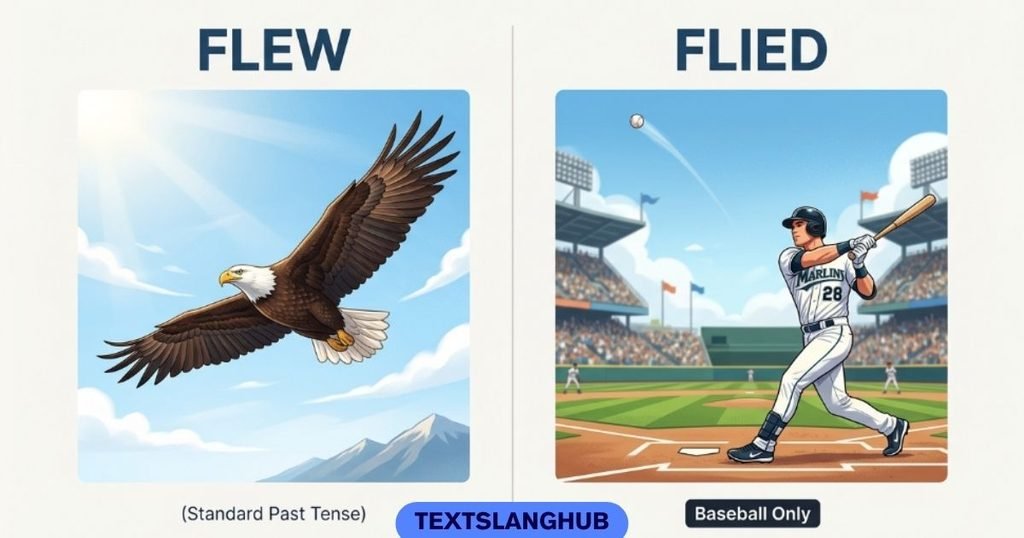
Here’s a curveball almost every guide skips. In baseball, “to fly” means to hit a fly ball. And in that one sport, the past tense isn’t flew — it’s flied.
- The batter flied out to center field. ✅
- The batter flew out to center field. ❌
Weird, right? So a bird flew over the stadium while the batter flied out inside it — same base word, two different past tenses depending on the meaning. Unless you’re talking baseball, you’ll never need flied. But now you won’t panic if you spot it.
“Time flew by” or “time has flown by”?
This idiom is one of the top real reasons people even search flew or flown — so let’s settle it. Both are correct; it just depends on the helper.
- Time flew by. ✅ (simple past, no helper)
- Time has flown by. ✅ (present perfect, helper has)
- Time has flew by. ❌
- Time flown by so fast. ❌
Same rule as always. Flew stands alone; flown rides with has/have/had.
There’s a related old-school phrase too: “the bird has flown.” It means someone has already left or slipped away — like the suspect had flown before police arrived. You’ll mostly meet it in books and crime shows, but it follows the exact same grammar.
Read Also: Quieter vs More Quiet: Which One Is Actually Correct?
The mistakes people make (and the quick fix)
These four errors show up constantly. Catch them and you’re ahead of most native speakers.
- “I have flew there.” ❌ → I have flown there. ✅ (Helper have needs flown*.)*
- “She had flew home.” ❌ → She had flown home. ✅
- “I flown to Miami last week.” ❌ → I flew to Miami last week. ✅ (No helper, so it’s flew*.)*
- “The kite has flew away.” ❌ → The kite has flown away. ✅
See the theme? People swap the two whenever a helper verb is nearby. The one-second test up top fixes all four in a heartbeat.
Quick decision guide: flew or flown?
Run through this in your head:
- Is there a has, have, had, was, or were right before the blank?
- Yes → flown.
- No → keep going.
- Are you just saying something happened in the past, with the word standing alone?
- Yes → flew.
- Talking about baseball fly balls?
- Yes → flied (the odd one out).
Ninety-nine percent of the time you’ll land on flew or flown in a single step.
FAQ
When to use flew or flown?
Use “flew” for a plain past action that stands alone, like “I flew home.” Use “flown” with a helper word such as has, have, or had, like “I have flown.”
Is the word flown correct?
Yes, “flown” is correct. It is the past participle of “fly,” and it always needs a helper word like has, have, or had beside it.
Is it time has flown by or flew by?
Both work. Say “time flew by” for a plain past action. Say “time has flown by” when the helper word “has” comes first.
Is flew correct grammar?
Yes, “flew” is correct grammar. It is the simple past tense of “fly,” and it stands on its own, like “The plane flew fast.”
What verb is flew?
“Flew” is the verb “fly.” It is the simple past form, so the full set reads fly, flew, flown.
The bottom line
The choice between Flew or Flown is simple once you learn one small rule. You use “flew” when the word stands alone. You write “flew” for a plain past action, like “I flew home last night.” You use “flown” when a helper word comes first. Words like has, have, or had always need “flown,” like “I have flown before.”
Now you hold the full rule in your hands. Look for a helper word each time you write. A helper word points you to “flown.” No helper word points you to “flew.” Practise with a few short sentences today, and this skill will feel natural soon. You can trust yourself now. You now understand Flew or Flown with ease.
Related Guides:
1: What Does SN Mean in Texting? Say Nothing & More
2: Hu Meaning in Text (Who, Huh or Hook Up?)
3: SH Meaning in Text: What It Actually Means (Same Here & More)
4: GL Meaning in Text: What It Actually Means
5: Anyone Has or Have? The One Rule That Settles It






2 Comments