
Anyone Has or Have? The One Rule That Settles It
Stuck on “anyone has or have”? You’re not alone — this one trips up native speakers and English learners every single day. The short version: both are correct, but they belong in different sentences. Choose the wrong one and your text, email, or essay looks a little off. Below you’ll get the fast answer, the single rule that fixes it forever, and real examples you can copy.
Featured answer: “Anyone has or have” depends on the sentence. Use has in simple statements because anyone is singular: “If anyone has time…” Use have after auxiliary verbs like do, does, or did: “Does anyone have a pen?” The helping verb carries the tense, so the main verb stays have.
Anyone has or have: the 5-second answer
No auxiliary verb → has.
Auxiliary verb in front → have.
- “Anyone who has a ticket can enter.” ✅
- “Does anyone have a ticket?” ✅
That’s the whole thing. If you remember nothing else, remember those two lines. The rest of this guide just explains why, so it sticks.
The one rule that decides it
Here’s the logic in plain English.
Anyone is an indefinite pronoun, and it’s grammatically singular — even though it feels like it points to a group. Singular subjects in the present simple take has (third-person singular), the same way “she has” or “he has” works.
So when anyone is doing the action directly, use has:
“Anyone has the right to stay quiet.”
But the moment a helping verb (do, does, did, can, will, should, and friends) shows up, everything changes. That helping verb takes over the tense and the agreement. The main verb then drops back to its plain base form — which is have, not has.
“Does anyone have the right paperwork?”
You’d never say “Does she has.” Same rule. The does already did the singular work, so have stays bare. That’s the entire trick behind “anyone has or have.”
Does anyone have or does anyone has?
This is the #1 mistake, so let’s kill it fast.
✅ “Does anyone have a charger?”
❌ “Does anyone has a charger?”
The word does is already third-person singular. Stacking has on top double-conjugates the sentence, which is why it sounds clunky to fluent ears. After do, does, or did, always use have.
Real chat:
Maya: does anyone have Priya’s number?
Jon: yeah sending it now
Jon wouldn’t blink at that. Swap in “does anyone has” and it instantly reads like a typo.
Has anyone or have anyone?
Now flip the sentence into a question that starts with the verb. People second-guess this one constantly.
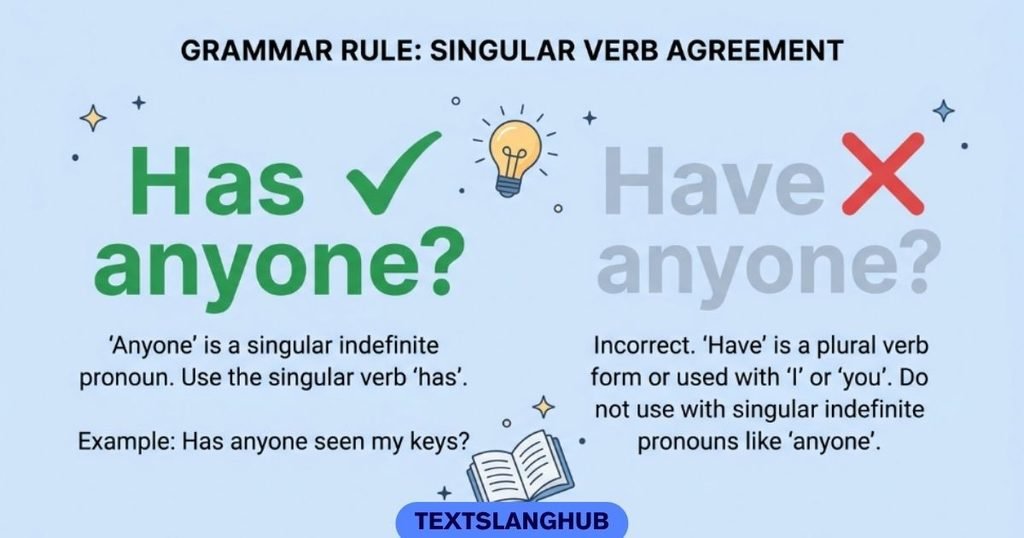
✅ “Has anyone seen my keys?”
❌ “Have anyone seen my keys?”
Because anyone is singular, the matching auxiliary is has, not have. Think of it as “Has he seen my keys?” — same shape, same singular verb. In “has/have anyone” questions, it’s basically always has anyone.
Quick side-by-side you can screenshot:
| You want to ask… | Correct | Wrong |
| A question with do/does | Does anyone have…? | Does anyone has…? |
| A present-perfect question | Has anyone…? | Have anyone…? |
| A statement | Anyone who has… | Anyone who have… |
When “anyone has” is the right choice
Plenty of people over-correct and start saying have everywhere. Don’t. When there’s no auxiliary verb and anyone is the subject, has wins:
- “If anyone has questions, drop them below.” ✅
- “Anyone who has finished can leave early.” ✅
- “It’s rare that anyone has all the answers.” ✅
Notice the pattern: anyone sits right next to the verb, nothing helping it. Singular subject, singular verb, done.
Read Also: NSFW Meaning in Text: What It Really Stands For
The 3-word test that never fails
Here’s the shortcut competitors skip. Before you type has or have, scan for a helping verb — do, does, did, can, could, will, would, should, may, might, must.
- Spot one? → use have. (“Can anyone have two slices?”)
- See none? → use has. (“Anyone here has two slices already.”)
Say it out loud with “he” if you’re unsure. “Does he have?” sounds right; “Does he has?” sounds broken. Anyone behaves exactly like he or she here. That one swap solves 95% of “anyone has or have” moments.
Real texts, decoded
Scenario 1 — group chat panic
Sam: does anyone have a phone charger 🙏
Dana: i do, iphone or android?
Does is present, so have is correct. Perfect.
Scenario 2 — the lost-item hunt
Alex: has anyone seen my AirPods case??
Priya: check the couch lol
Question led by the verb → singular anyone → has anyone. Also correct.
Scenario 3 — a heads-up in an email
“If anyone has feedback on the deck, send it by Friday.”
No auxiliary, anyone is the subject → has. Clean and professional.
Three different structures, three different verbs — and every one follows the same rule.
“Has anyone got” vs “does anyone have”
Small twist worth knowing if you write for a global audience.
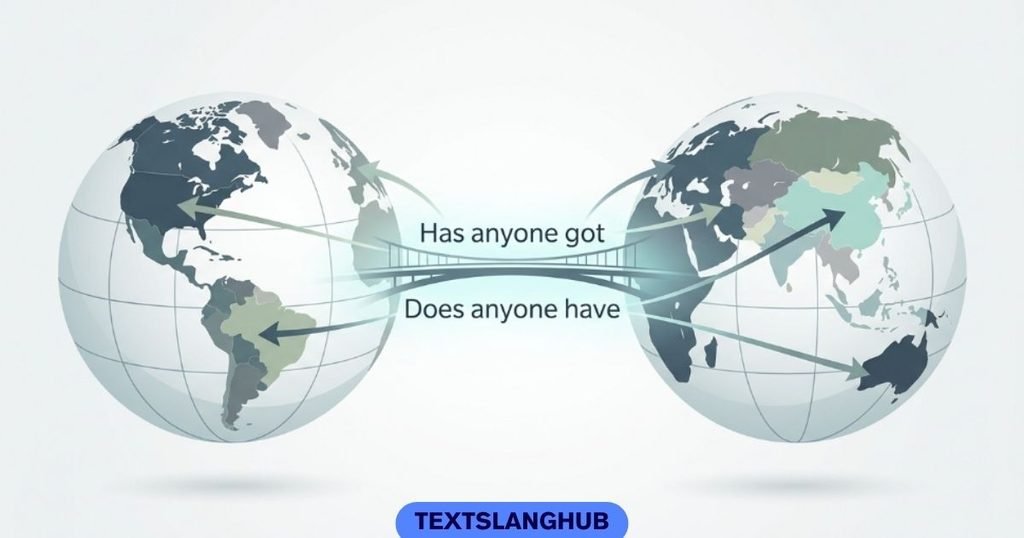
British English often reaches for “Has anyone got…?”
“Has anyone got a spare pen?”
American English usually prefers “Does anyone have…?”
“Does anyone have a spare pen?”
Both are correct — they’re just regional styles. Notice the pattern still holds: has pairs with the verb directly, while have follows the auxiliary does. Same rule, two accents.
The mistakes that make you look careless
- Double conjugating: “Does anyone has…” — very common, always wrong.
- Over-correcting statements: “Anyone who have a login…” — should be has.
- Flipping the question: “Have anyone tried this?” — should be has anyone.
- Copying the plural feeling: anyone sounds like “a lot of people,” so folks use have. But grammar treats it as one, so keep it singular in statements.
These slip out most in fast texting, but they also sneak into cover letters and emails, where they cost you more.
Send it or fix it: a quick decision guide
Walk it in your head before you hit send:
- Is there a helping verb (do/does/did/can/will…) in the sentence? → have
- No helping verb, and anyone is the subject? → has
- Starting the question with the verb itself? → has anyone
Run those three checks and you’ll never stall on “anyone has or have” again.
Read Also: BR Meaning in Text: What It Stands For (and How to Tell Which One)
What about “everyone has or have”?
Bonus, because you’ll hit this next: everyone, someone, no one, and each follow the exact same rule as anyone. All singular.
- “Everyone has a role.” ✅
- “Does everyone have a role?” ✅
Learn the pattern once and it covers the whole family of indefinite pronouns.
FAQ
Does anybody else have or has?
Say “does anybody else have.” The word does already carries the singular tense, so the main verb stays have.
Is anyone singular or plural?
Anyone is grammatically singular. It always takes a singular verb, just like he or she does.
Do we use has or have for anyone?
Use has when anyone stands alone as the subject. Use have after a helping verb like do, does, or did.
Is it correct to say “does anyone have”?
Yes, “does anyone have” is perfectly correct. The auxiliary does handles agreement, so the base form have follows.
Which is correct, “anyone has” or “anyone have”?
Both fit different sentences. Use has with no helping verb (“anyone who has time”) and have after one (“does anyone have time”).
The takeaway
The whole “Anyone Has or Have” puzzle comes down to one small clue. You just look for a helping word. If you see do, does, or did in front, you pick have. So you write “Does anyone have a pen?” every time. When anyone sits right next to the verb alone, you pick has. So you write “Anyone who has time can help.”
Keep this simple habit close. Test the sentence with “he” when you feel unsure. “He has” and “he have” show you the answer fast. This one trick clears up “Anyone Has or Have” for good. You can now write clean texts, neat emails, and strong school work. Practice it a few times, and soon the right word will feel natural.
Related Guides:
1: What Does WYO Mean? The Texting Slang, Decoded
2: What Does TS Stand For in Text? Meaning, Examples & How to Reply
3: KK Meaning in Text: What It Stands For and How to Use It
4: What Does ASL Mean Texting? Here’s the Real Answer
5: HYD Meaning in Text: What It Means and How to Reply






One Comment