
Quieter vs More Quiet: Which One Is Actually Correct?
“Quieter vs more quiet” is one of those tiny grammar choices that makes people freeze mid-sentence. You know exactly what you mean. You just can’t decide which version sounds right — and the more you stare at both, the stranger they both start to look.
Good news: there’s a clear winner, and the rule behind it takes about ten seconds to learn.
Short version — quieter is the safe, natural pick almost every time. “More quiet” isn’t a mistake, but it fits only a small handful of moments. Let’s sort it out for good, with plain rules and real examples you can copy.
Quick answer: Quieter vs more quiet — “quieter” is the standard and more natural comparative form of “quiet,” and it’s correct in nearly every sentence. “More quiet” isn’t wrong, but it sounds formal or emphatic and works in only a few cases. When in doubt, choose “quieter.”
Which one wins? The short version
If someone put a gun to your keyboard, type quieter.
It’s the form you’ll see in books, news, style guides, and everyday texts. It reads smoothly and never sounds off. Native speakers reach for it automatically, without thinking about a single grammar rule.
“More quiet” is grammatically legal. It’s just the road less traveled — and most of the time, taking it makes your sentence sound a little stiff or overly careful, like you’re reading from a form.
So the whole debate really comes down to one habit: unless you have a specific reason to slow the reader down, default to quieter and move on.
Why “quieter” is the natural pick
English usually builds the comparative — the “-er / more” version — of an adjective in one of two ways:
- Short adjectives add -er: fast → faster, loud → louder, warm → warmer.
- Longer adjectives use more: careful → more careful, beautiful → more beautiful.
One-syllable words almost always take -er. Three-syllable words almost always take more. The messy middle is the two-syllable words — and “quiet” lives right there, which is the whole reason people hesitate.
Here’s the tiebreaker. By long habit and heavy usage, “quiet” behaves like a short adjective. So it takes -er and becomes quieter. That’s why “quieter” feels right to native ears even before anyone explains the logic. Your gut isn’t guessing — it’s matching the pattern it’s heard ten thousand times.
Is “more quiet” ever correct?
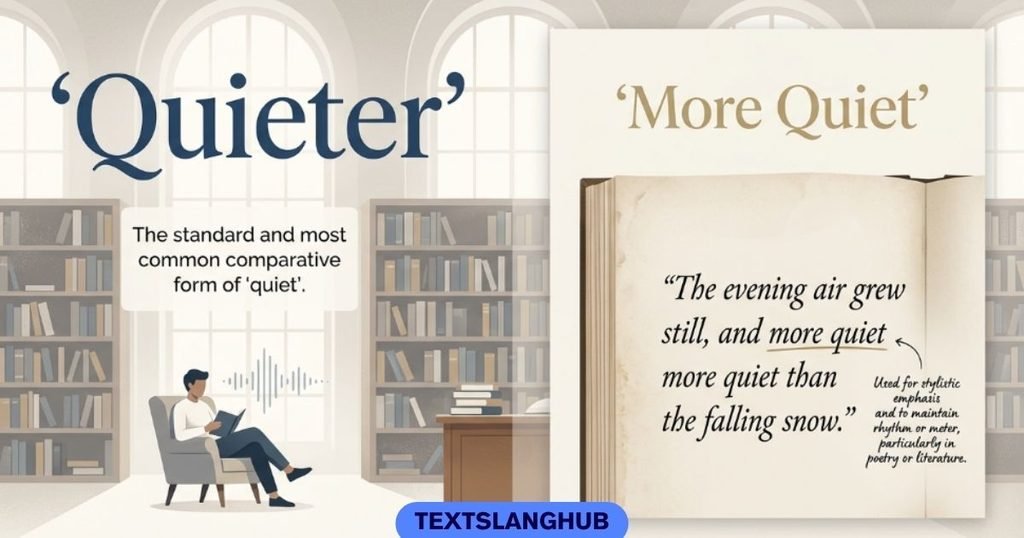
Yes — just rarely. It’s not banned, and there are a few spots where it earns its place.
1. For contrast or emphasis. When you’re stressing a change, “more quiet” can slow the reader down on purpose.
“After the news, the whole house felt more quiet than before.”
2. In a parallel list. When “more” is already doing work on nearby words, matching them can sound cleaner.
“The evening grew more quiet, more still, more heavy.”
3. In formal or literary writing. Some authors reach for “more quiet” for rhythm, balance, or an old-fashioned tone.
Even in these cases, “quieter” would usually still work. Think of “more quiet” as a stylistic option you choose on purpose — not a grammar requirement you’re forced into.
Read Also: What Does SN Mean in Texting? Say Nothing & More
See them side by side
Here’s how the two forms feel in real use:
| Sentence | Verdict |
| “Can we find somewhere quieter to talk?” | ✅ Natural |
| “Can we find somewhere more quiet to talk?” | ⚠️ Understandable but stiff |
| “This laptop is much quieter than my old one.” | ✅ Natural |
| “The library got more quiet after 9 p.m.” | ⚠️ Okay, but “quieter” reads better |
| “She’s quieter than her sister.” | ✅ Natural |
| “The city feels quieter on Sundays.” | ✅ Natural |
Now a quick text-thread version so you can hear the difference:
Maya: honestly need somewhere quieter, this café is chaos 😩
Jon: the co-working spot by the park is way quieter, let’s go there
Swap in “more quiet” and it suddenly sounds like a robot texting. That’s your gut check in action.
The read-aloud test that settles it fast
If a table isn’t handy, use your ears. Say the sentence out loud both ways and notice which one your mouth wants to say.
Try it: “It’s quieter now.” versus “It’s more quiet now.”
Most people breeze through the first and stumble slightly on the second. That little stumble is the sound of an unnatural form. Your speaking instinct is usually a better guide than any rule, because it’s built from years of real English.
This trick works for other two-syllable adjectives too. When you’re stuck between “-er” and “more,” say both. The smoother one is almost always the right one.
Quietest vs most quiet: the superlative twin
Same question, one step up. When you go from “more” to “most,” the rule holds.
- Quietest = standard and natural. “It was the quietest night all week.”
- Most quiet = technically fine, rarely the best choice.
So the pairing is simple:
- quiet → quieter → quietest (your everyday forms)
- quiet → more quiet → most quiet (formal or emphatic, and much less common)
If you’ve locked in “quieter,” you already know to say “quietest.” They travel together as a set. Learn one and you’ve learned both.
The two-syllable trap that trips people up
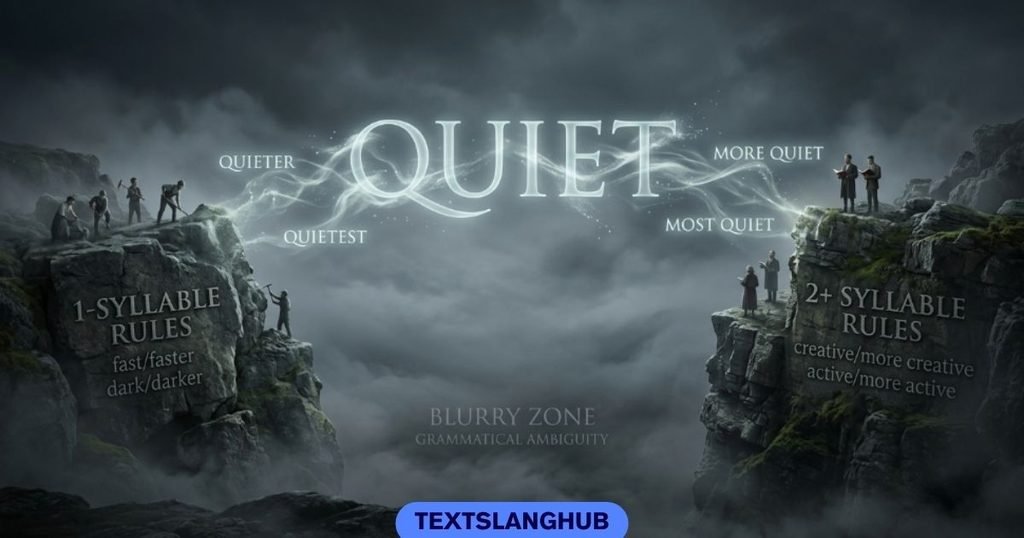
Here’s the piece most explainers skip. People don’t get confused by accident — they get confused because “quiet” sits in English’s blurriest zone.
Two-syllable adjectives are wildly inconsistent. Some take -er (narrow → narrower, gentle → gentler, simple → simpler, clever → cleverer). Others take more (famous → more famous, careful → more careful, useful → more useful). There’s no perfectly clean rule that covers all of them, which is why even confident writers pause.
So when your brain hits “quiet,” it hesitates — should it act like “simpler” or like “more careful”?
The tiebreaker, again, is usage. Real English overwhelmingly says quieter, so that’s the form that sounds correct. “More quiet” isn’t wrong; it just lost the popularity contest by a mile.
Bottom line: the confusion is real, but the answer isn’t. Default to quieter and you’ll match how people actually write and speak.
Where each one shows up in real life
You’ll notice a pattern once you start listening for it.
“Quieter” dominates casual, spoken, and digital spaces — texts, DMs, chats, reviews, captions, everyday conversation. If it’s informal, “quieter” is almost guaranteed.
“More quiet” shows up more in formal essays, poetry, older books, and moments where a writer is deliberately reaching for rhythm or drama. It’s a “chosen” form, not a default one.
So the register is a clue. Firing off a quick message? Quieter. Writing a slow, atmospheric line in a story? “More quiet” becomes a real option worth considering.
Mistakes to avoid
A few slip-ups pop up again and again:
- “More quieter.” This is a double comparative and it is wrong. Pick one — “more” or “-er,” never both. Say quieter.
- Overusing “more quiet” to sound formal. It often does the opposite and sounds clumsy or unsure.
- Mixing forms in one sentence: “quieter and more calm.” Stay consistent where you can — “quieter and calmer” flows better.
- Assuming “more quiet” is flat-out incorrect. It’s not. It’s just uncommon. Don’t “correct” someone as if they broke a real rule.
Read Also: Hu Meaning in Text (Who, Huh or Hook Up?)
Pick the right one in 3 seconds
When you’re mid-text and unsure, run this:
- Default to “quieter.” It’s right the vast majority of the time.
- Are you stressing a change or contrast? “More quiet” is an option — but “quieter” still works.
- Did you almost type “more quieter”? Stop. Delete “more.” Keep “quieter.”
That’s it. No grammar degree required.
Frequently asked questions
Is it more quiet or quieter?
“Quieter” is the correct and natural choice almost every time. Use “more quiet” only in rare formal or emphatic sentences.
Does the word “quieter” exist?
Yes, “quieter” is a real, standard English word. It is the comparative form of “quiet.”
What is the comparative for quiet?
The comparative for “quiet” is “quieter.” It compares two things, as in “This room is quieter than that one.”
What does quieter mean?
“Quieter” means less loud or more calm than something else. It shows a lower level of noise.
How do you say quieter?
You say it as “KWY-uh-ter,” with three quick beats. The stress falls on the first part, “KWY.”
The takeaway
So now you know the answer to Quieter vs More Quiet. The word “quieter” wins almost every time. You can use it in texts, in class, and in your books. It sounds smooth, and it always sounds right. You should also remember its partner word, “quietest.” These two words go together, so learning one helps you learn both. Keep them close in your mind.
You can still use “more quiet” sometimes. It fits well in slow, formal writing when you want to add weight to a line. But you must never write “more quieter.” That form breaks the rule. Follow these simple tips, trust your ears, and pick “quieter” with full confidence. You will sound clear, correct, and just like a real native speaker.
Related Guides:
1: SH Meaning in Text: What It Actually Means (Same Here & More)
2: GL Meaning in Text: What It Actually Means
3: Anyone Has or Have? The One Rule That Settles It
4: NSFW Meaning in Text: What It Really Stands For
5: BR Meaning in Text: What It Stands For (and How to Tell Which One)


3 Comments